
Service Ecosystem
A unique visualization to deliver
insights right from the start of a service design project.
A service ecosystem visualizes the broad range of interactions and touchpoints that come into play across a customer lifecycle, and it does so with just a few layers of information. Yet despite its simple structure, it provides important new insights for the team that creates it. Like customer journey maps and service blueprints, a service ecosystem is a chronological view of a service experience, but it only concerns itself with phases, rather than the precise order of events within them. Within the phases, the user's needs are identified, alongside the service interactions, and the touchpoints on which they take place.

Service Ecosystems Layers Explained

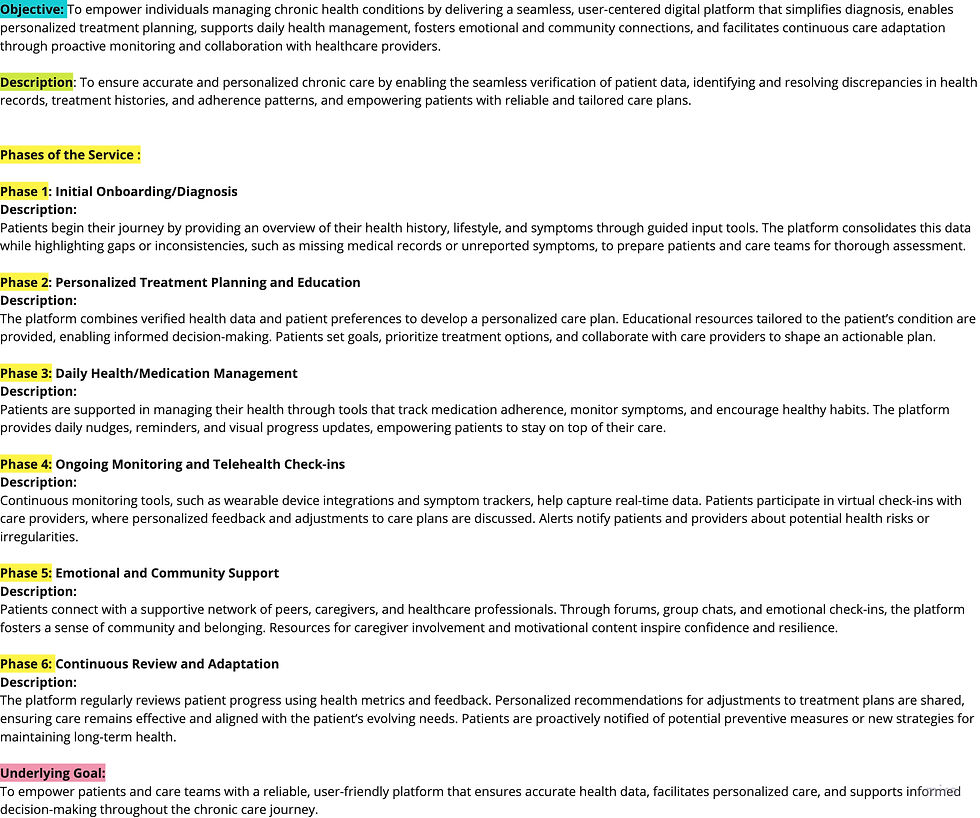

Next Steps/ Opportunities

Chronic Care Management (Detailed)
-
Challenge: Patients might feel overwhelmed by the complexity of their health conditions or the platform, leading to disengagement or non-adherence.
-
Solution:
-
Use a phased onboarding process that introduces features gradually rather than overwhelming users with the entire system at once.
-
Gamify engagement through rewards, badges, or progress milestones to motivate users to stay active in their health journey.
-
Provide personalized educational resources in multiple formats (videos, articles, infographics) to suit diverse learning preferences.
-
Gap: Emotional and Social Isolation
-
Challenge: Patients managing chronic conditions often experience emotional distress or feel isolated, which can negatively impact their health outcomes.
-
Solution:
-
Create a community feature where patients can join condition-specific groups, share experiences, and receive peer support.
-
Integrate emotional health check-ins with tools like mood trackers and access to mental health resources.
-
Partner with caregivers and involve them in the platform through shared access, ensuring a more robust support system.
-
REFLECTIONS : GAPS, CHALLENGES, SOLUTIONS.
Gap: Lack of Integration with Existing Systems
-
Challenge: Healthcare providers and patients may already use disparate systems that don’t communicate well, leading to delays in care coordination.
-
Solution:
-
Build the platform with interoperability in mind, adhering to healthcare data standards like HL7 and FHIR.
-
Enable seamless data exchange with EHR systems, pharmacies, lab services, and wearable devices.
-
Include APIs for third-party integrations and a centralized dashboard for patients to view all their health information in one place.
-
Gap: Usability for Diverse Populations
-
Challenge: Users with varying levels of digital literacy or physical/cognitive impairments may struggle to use the platform effectively.
-
Solution:
-
Prioritize accessibility by designing the platform in compliance with WCAG (Web Content Accessibility Guidelines).
-
Include voice recognition features, larger fonts, simplified navigation, and options for screen readers to make the platform inclusive.
-
Test prototypes with a diverse group of users to identify usability barriers and refine the design.
-
Gap: Insufficient Proactive Support
-
Challenge: Patients may not receive timely alerts or follow-ups for missed medications, abnormal symptoms, or overdue check-ins, increasing risks.
-
Solution:
-
Implement real-time alerts and reminders for medication schedules, symptom updates, and upcoming appointments.
-
Use predictive analytics to identify patterns that indicate potential health risks and provide proactive recommendations.
-
Empower care teams with dashboards highlighting at-risk patients who need immediate attention.
-
Gap: Resistance from Healthcare Providers
-
Challenge: Providers might resist adopting new technologies due to workflow disruptions or skepticism about its impact.
-
Solution:
-
Involve providers early in the design process to ensure the platform aligns with their workflows and needs.
-
Highlight time-saving features like automated summaries and decision support tools to reduce administrative burden.
-
Provide robust training and ongoing technical support to build confidence and competence in using the platform.
-
Gap: Inadequate Feedback Mechanisms
-
Challenge: Without consistent feedback from patients and providers, the platform may fail to adapt effectively to user needs.
-
Solution:
-
Establish regular feedback loops through surveys, in-app feedback options, and focus groups.
-
Incorporate analytics to track usage patterns and identify areas where users struggle or drop off.
-
Use feedback to prioritize iterative improvements and keep the platform relevant and user-friendly.
-
Gap: Data Accuracy and Completeness
-
Challenge: Patients may provide incomplete or inconsistent health data due to memory gaps, lack of access to previous records, or misunderstanding of the input process. Similarly, healthcare providers may have fragmented or siloed data systems.
-
Solution:
-
Implement automated data verification tools that cross-reference patient inputs with external sources (e.g., EHRs, pharmacy records, lab results).
-
Design user-friendly data collection interfaces with guided prompts and error-checking mechanisms to reduce mistakes during input.
-
Offer real-time support (e.g., chatbots or human assistants) for patients during onboarding to clarify questions and ensure accurate data capture.
-
Gap: Limited Patient Engagement

1. User Needs
Representing the user-centred focus of service design, the service ecosystem places the user at the heart of the visualization. The user's “underlying need” occupies the very centre of the circle, while needs specific to individual phases are located in the relevant segments of the next ring outwards.
Structure of a Service Ecosystem:
Let's take a look at the elements of a service ecosystem, from the inside out.
Firstly, a service ecosystem is structured as a set of concentric rings, and reads clockwise from the ‘12 o’clock’ position, phase-by-phase. This ring-based visualisation sets it apart from typical customer journey maps and service ecosystems, and also emphasises the fact that some service experiences don’t fully end, but begin anew with the discovery and consumption of new products. It also emphasises the holistic nature of the ecosystem – encompassing all its elements within clear boundaries, as opposed to the sprawling, linear nature of blueprints and journeys.
2. Interactions
Discrete interactions the user has with the service.
Within a segment of the “Interactions” ring corresponding to a phase, no order is implied by where interactions are positioned. The interactions are also written without reference to a touchpoint, to avoid bogging down the document in unnecessary detail
3. Touchpoints
The places on which the interactions of a given phase occur are gathered together in the next ring outwards: “Touchpoints”. Here, touch-points that play a role in a specific phase are named.

4. Phases
The outermost ring is self-explanatory – it contains the high-level phases of the service that the user progresses through